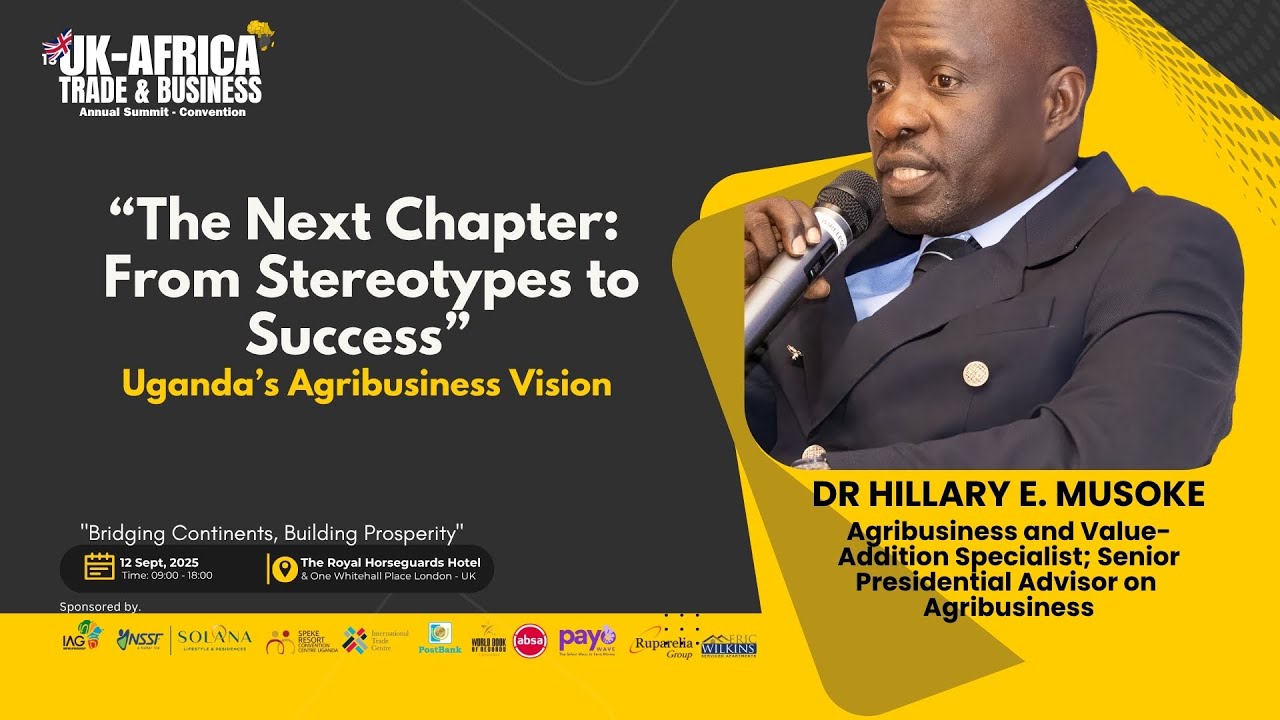
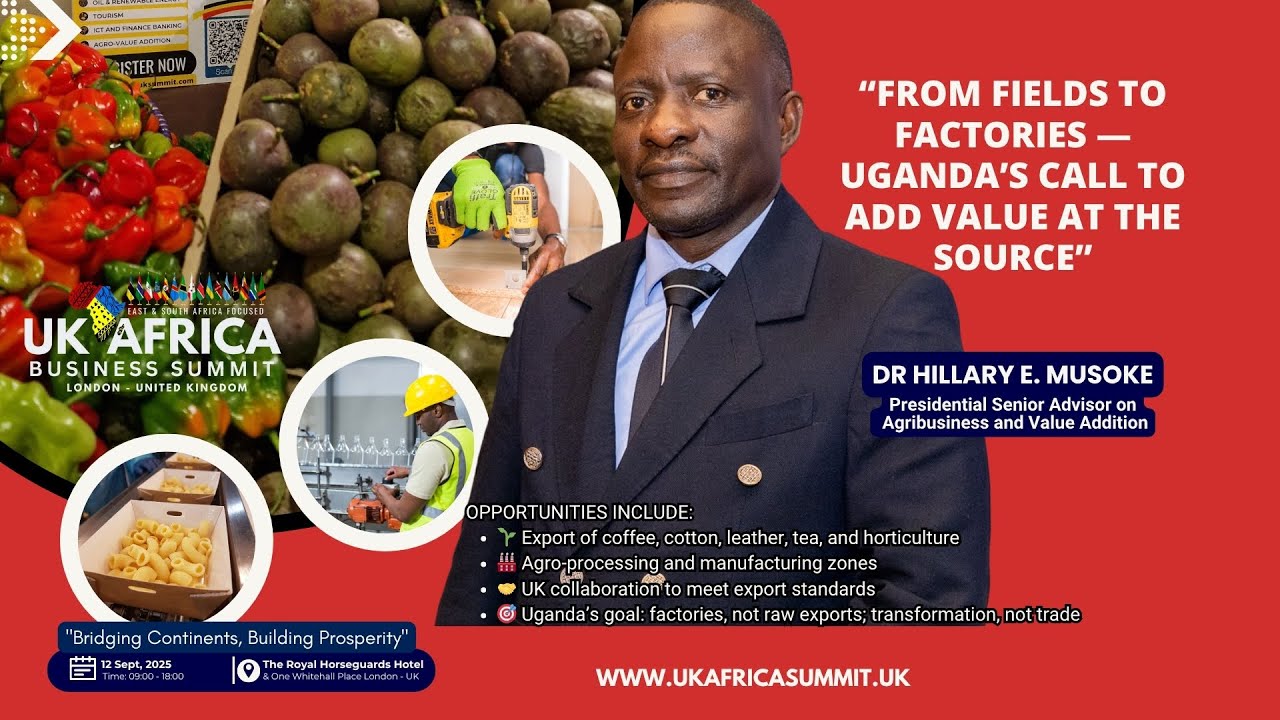
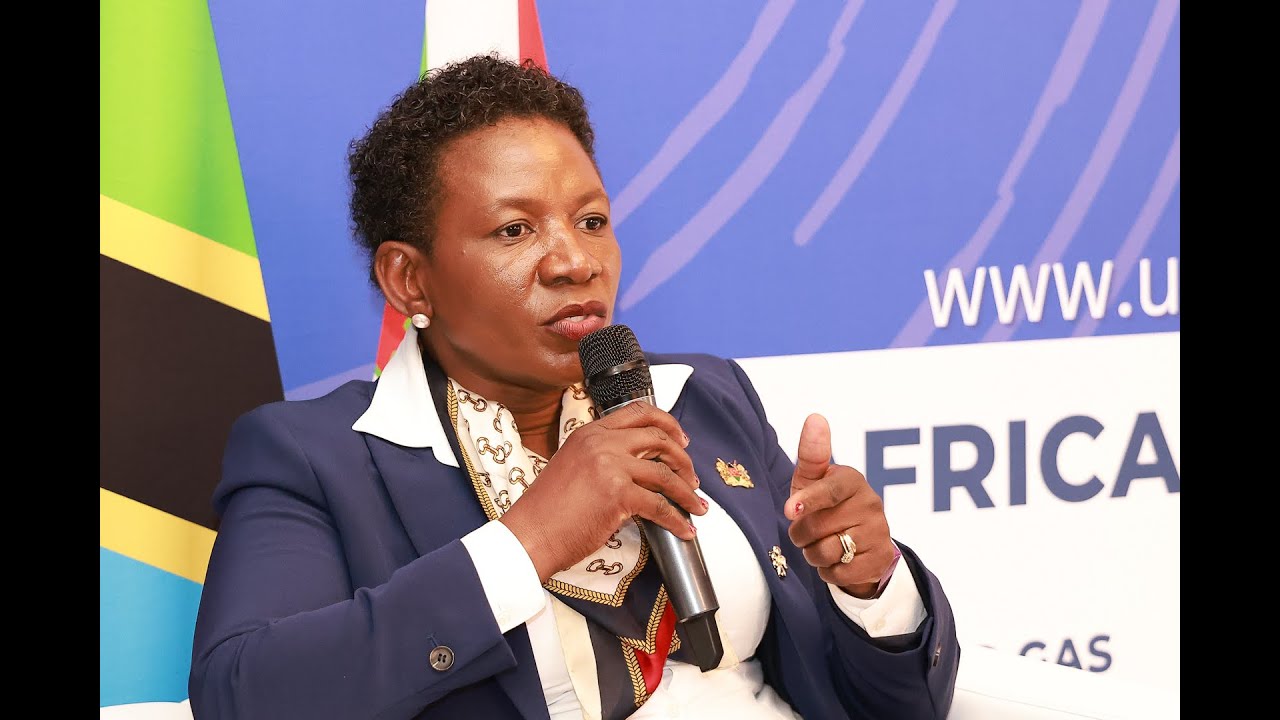
At the 15th UK–Africa Business, Trade & Investment Summit, Dr. Hillary Emma Musoke, Senior Presidential Advisor on Agribusiness and Value Addition, delivered a powerful message: Uganda’s agricultural future lies in value addition, industrialisation, and export readiness.
Speaking passionately about Uganda’s potential, Dr. Musoke reaffirmed that agriculture remains the nation’s economic backbone — the engine of job creation, rural transformation, and sustainable development. He described Uganda’s fertile soils, abundant rainfall, and youthful population as the foundation for a global agribusiness powerhouse.
“We are no longer the forgotten children — Uganda is back, and we are ready.”
He urged UK investors and the Ugandan diaspora to transition from aid narratives to enterprise partnerships — investing in agro-industrial ventures that create jobs, reduce post-harvest losses, and strengthen export value chains.
Uganda’s Competitive Edge in Agribusiness
Dr. Musoke highlighted the nation’s compelling advantages:
• 🌱 Fertile, arable land and a favourable climate for year-round cultivation.
• 🌾 Over 50 viable cash crops including coffee, tea, cocoa, cotton, and horticulture.
• 🧑🌾 A skilled, youthful labour force ready for agro-industrial employment.
• 🌍 Regional market access to more than 300 million consumers across East Africa.
“Uganda is ready — not just to grow crops, but to process, package, and export finished products to global markets.”
The Export Challenge: A Call to the UK
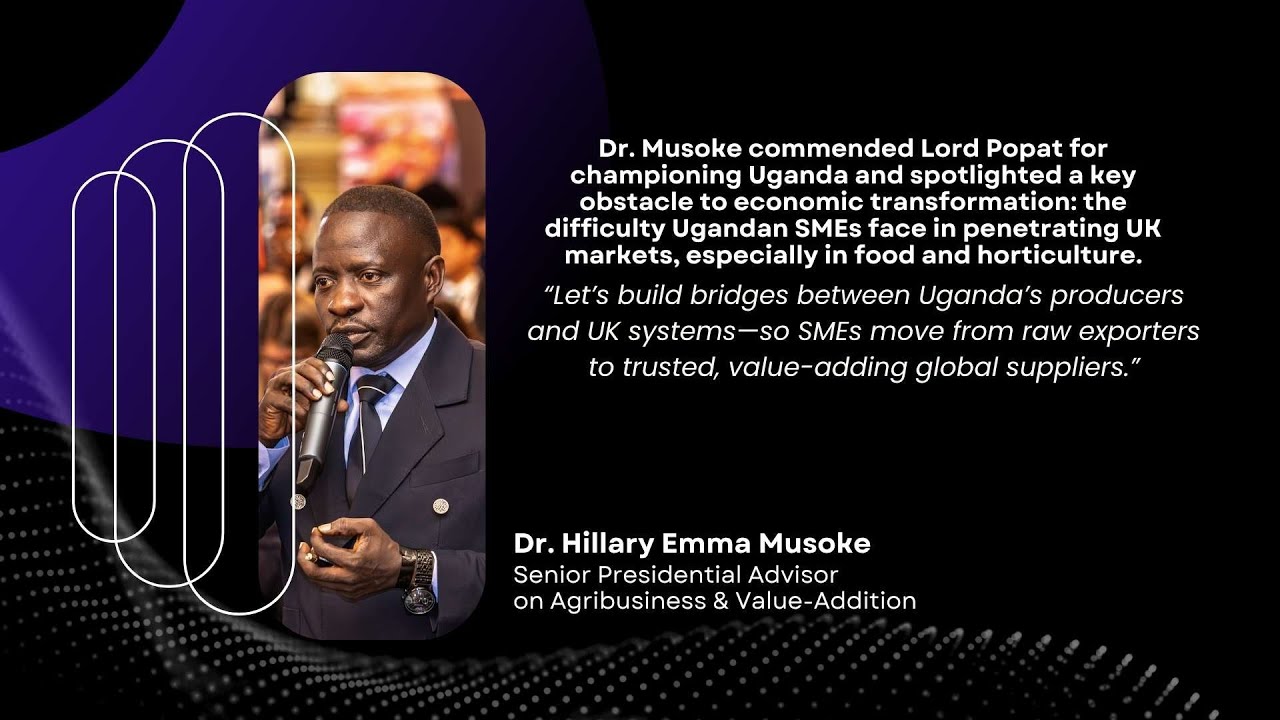
In his dialogue with Lord Dolar Popat, Conservative Life Peer and former UK Prime Minister’s Trade Envoy to Uganda, Rwanda, and the DRC, Dr. Musoke raised a vital question:
“How can Uganda’s small and medium enterprises — especially in food and horticulture — successfully penetrate the UK market given the stringent standards, regulatory frameworks, and compliance challenges they face?”
He identified four major barriers:
- Regulatory & Standards Barriers – Meeting UK and EU food safety, hygiene, and traceability requirements.
- Market Access Gaps – Weak certification and quality assurance systems.
- Knowledge & Capacity Deficits – Limited export-readiness training.
- Need for Collaboration – Stronger UK–Uganda technical cooperation and diaspora mentorship.
Lord Popat’s Response: From Compliance to Collaboration
Lord Dolar Popat applauded Dr. Musoke’s insights and reaffirmed the UK’s commitment to expanding two-way trade with Uganda. He noted that Uganda already enjoys duty-free access to the UK market, but tariffs are not the challenge — compliance and certification are.
“Uganda produces some of the world’s best coffee, tea, fruits, and even banana-fibre innovations. But unless we solve the standards and compliance gap, much of that value will remain unrealised.”
He outlined three key actions:
• For UK Stakeholders: British regulators, chambers, and buyers must engage Ugandan SMEs before shipment, providing pre-export certification, packaging guidance, and capacity-building.
• For Uganda: Accelerate reforms to strengthen traceability, documentation, and quality assurance.
• For the Diaspora: Bridge the compliance gap by co-investing in certification, co-branding, and retail partnerships.
“We can’t just talk about Uganda as a place to invest in. We must also buy from Uganda. That’s how we build a genuine two-way partnership.”
Policy Alignment and Future Outlook
Both leaders agreed that Uganda’s agribusiness transformation must rest on three pillars:
• Value Addition: Processing at source to capture higher export earnings.
• Compliance Capacity: Strengthening certification and training to meet UK and EU standards.
• Bilateral Ecosystem Building: Establishing permanent UK–Uganda business hubs linking producers, investors, and buyers.
Dr. Musoke invited UK investors to participate in Uganda’s growing agro-industrial ecosystem through industrial parks, cold-chain logistics, and packaging industries, noting that Uganda’s agricultural revolution depends on partnerships that convert raw potential into value-added prosperity.
“Come to Uganda. Visit our farms, tour our industrial parks, and partner with our entrepreneurs. Together, we can build an inclusive, export-driven agricultural economy.”
Key Takeaway:
Uganda’s next industrial revolution will be powered by agribusiness value addition, youthful innovation, and UK–diaspora collaboration. By bridging regulatory gaps and strengthening market access, Uganda can evolve from a raw commodity exporter into a global supplier of premium, processed agricultural products.
📸 View Event Photos
ukafricabusinesssummit.uk
🎥 Watch the Dialogue
Building Bridges Through Agribusiness & Value Addition – Dr. Hillary Emma Musoke in Conversation with Lord Dolar Popat
📺 ukeacsummit.uk
🎟️ Register for the 16th UK–Africa Business, Trade & Investment Summit 2026
📅 11 September 2026 | 🏛️ The Royal Horseguards Hotel & One Whitehall Place, London
🔗 ukafricasummit2026.eventbrite.co.uk
Follow the Conversation:
📢 @ukafricasummit | #UKAfricaSummit #UKAS2026 #AgribusinessAfrica #HillaryMusoke #DolarPopat #InvestInUganda #ValueAddition #TradeAfrica #AfricaInvestment #WillyMutenza #FoodSecurity #UKAfricaTrade