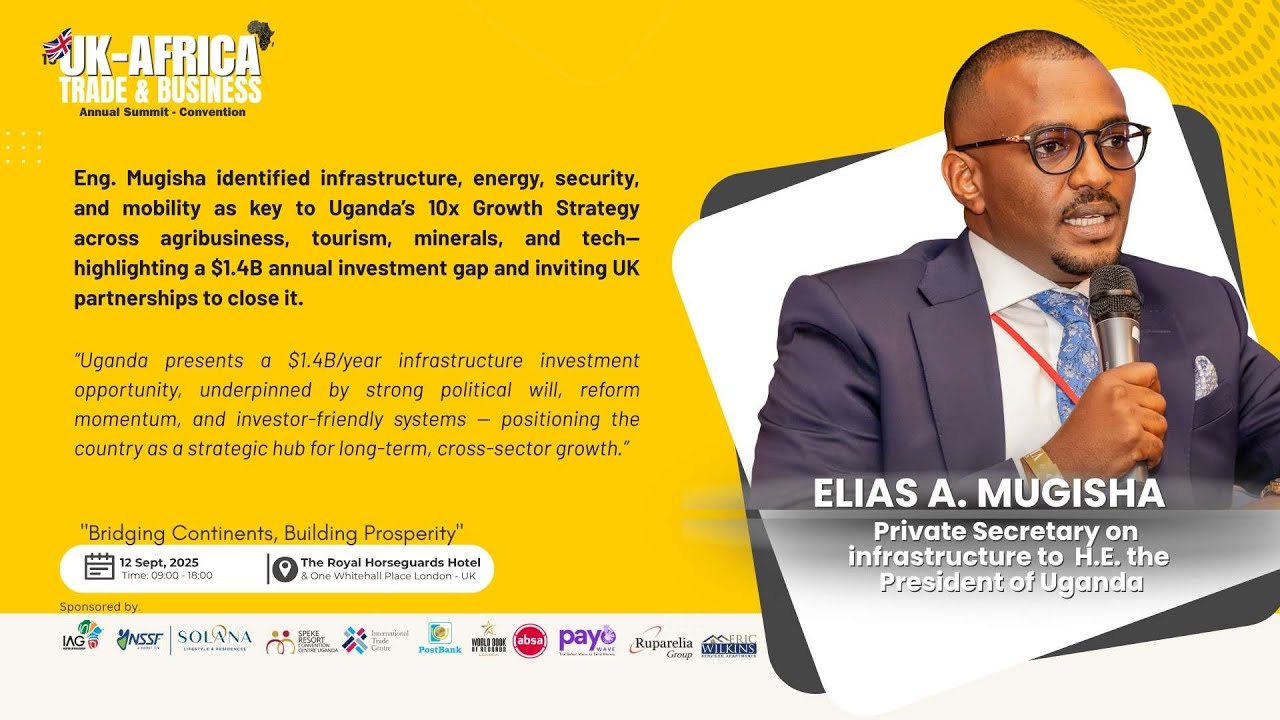
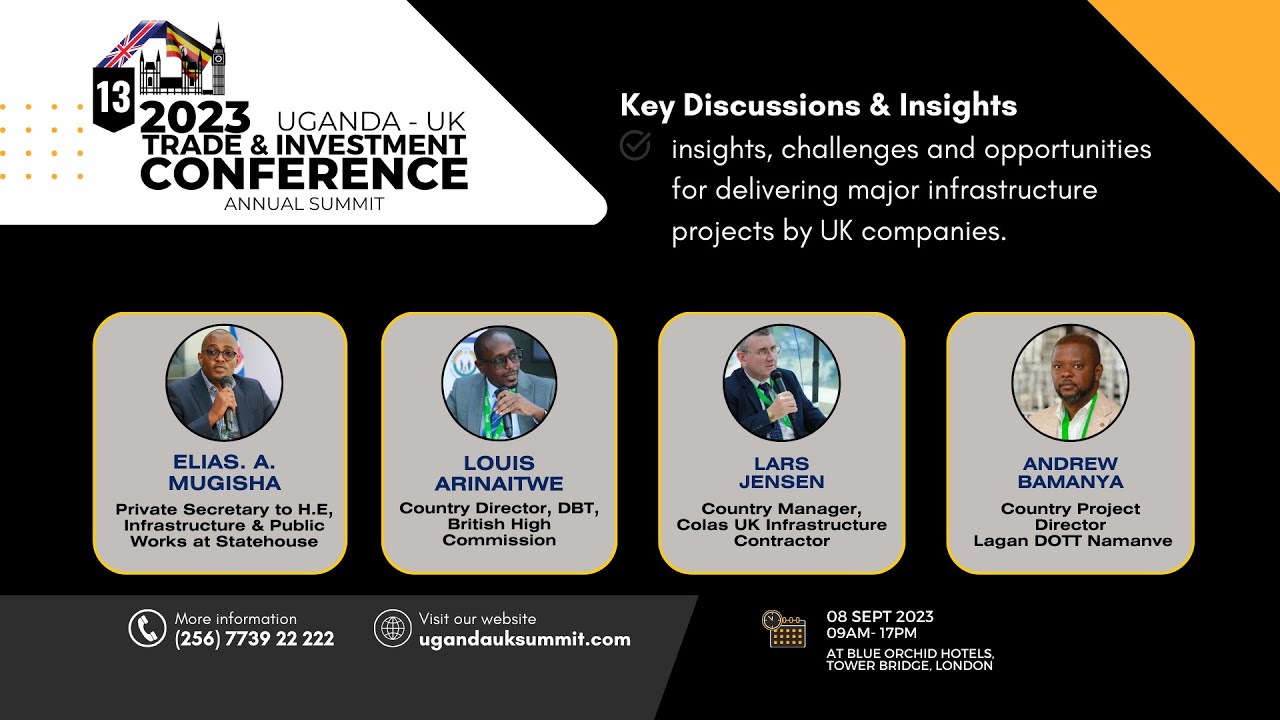
At the 15th UK–Africa Business, Trade & Investment Summit, Eng. Elias A. Mugisha, Private Secretary to H.E. the President of Uganda (Infrastructure & Public Works), outlined Uganda’s 10x Growth Strategy — a national framework positioning infrastructure as the foundation of accelerated industrialisation and inclusive development.
Anchored in four priority sectors — Agribusiness, Tourism, Minerals, and Science & Technology (ATMs) — the strategy identifies infrastructure, energy, mobility, and security as the primary enablers of transformation. Uganda faces an estimated $1.4 billion annual infrastructure investment gap, presenting significant opportunities for UK contractors, export credit agencies, and institutional investors seeking long-term, high-impact partnerships.
Opportunities & Competitive Advantages
Eng. Mugisha highlighted Uganda’s unique position as an investment-ready destination supported by direct Presidential oversight and streamlined project coordination:
• Direct supervision of flagship projects by the Presidency, ensuring high-level accountability.
• Active participation in the national steering committees for Karuma (600 MW) and Isimba (183 MW) hydropower plants.
• Integrated, cross-sector planning to maximise efficiency and cost-effectiveness.
• Infrastructure as a multiplier for industrialisation, tourism, energy access, and urbanisation — collectively shaping over 60% of production and consumer costs.
Call to Action
Eng. Mugisha invited UK partners to participate through:
• Project financing, contracting, and PPP structures to close Uganda’s investment gap.
• Leveraging UK Export Finance (UKEF) and blended-finance instruments for major projects.
• Supporting digital and data-driven planning systems to enhance transparency, monitoring, and delivery.
Policy and Investment Reforms
He presented measurable progress across Uganda’s governance systems:
• Public Investment Management System (PIMS): project approval times reduced from 700 days to under 12 months.
• Biometric National ID System: improving population data for planning, feasibility, and financing accuracy.
• Investor Protection Unit: a new State House mechanism for fast-tracking projects and resolving investor grievances.
Shaping Perceptions and Building Confidence
Eng. Mugisha acknowledged legacy inefficiencies but affirmed that reforms are active, measurable, and irreversible, driven by what he called “genuine goodwill at the highest levels of government.” He stressed that Uganda’s commitment to transparency, integration, and investor protection underpins every major infrastructure project.
Closing Message
“We are here to bridge the disconnect between the private sector and government. Uganda is open, committed, and ready to work with serious investors to build resilient infrastructure for sustainable development.”
Key Takeaway:
Uganda offers a $1.4 billion annual infrastructure opportunity, backed by political will, digital governance, and streamlined approvals. With robust institutional coordination under State House, Uganda is positioning itself as East Africa’s infrastructure and logistics hub — powering industrial growth, mobility, and sustainable transformation.