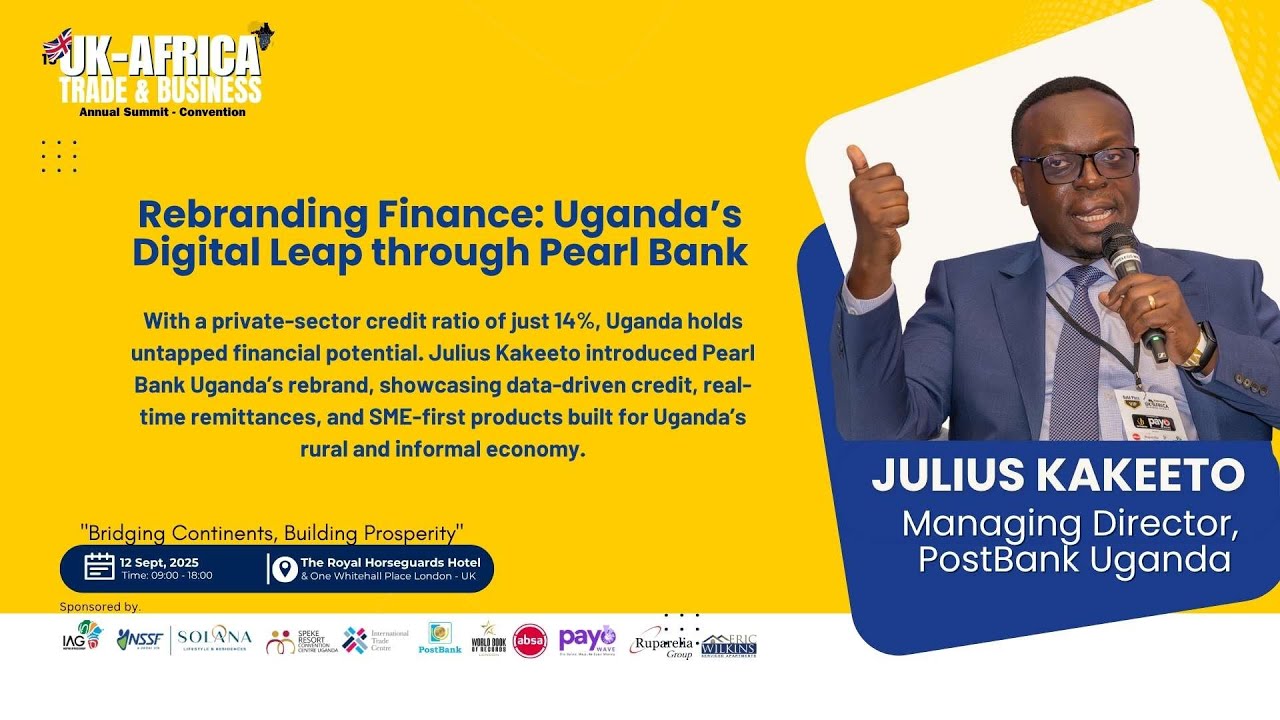
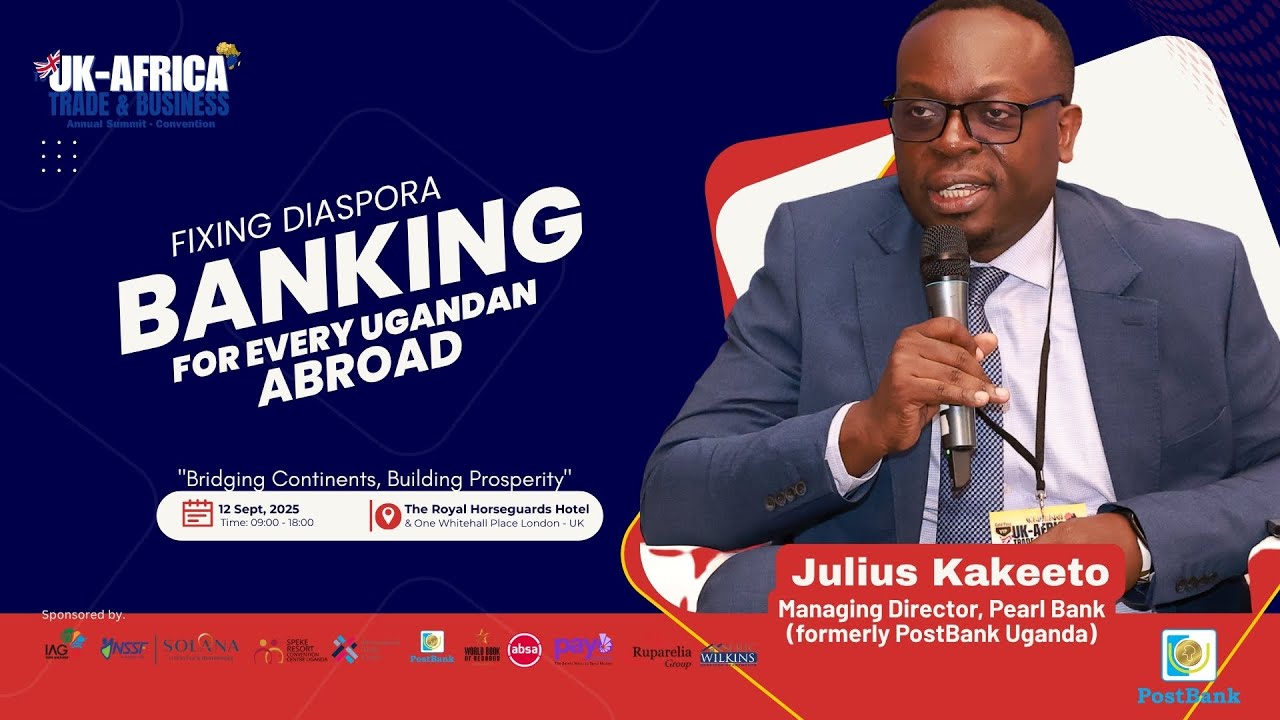
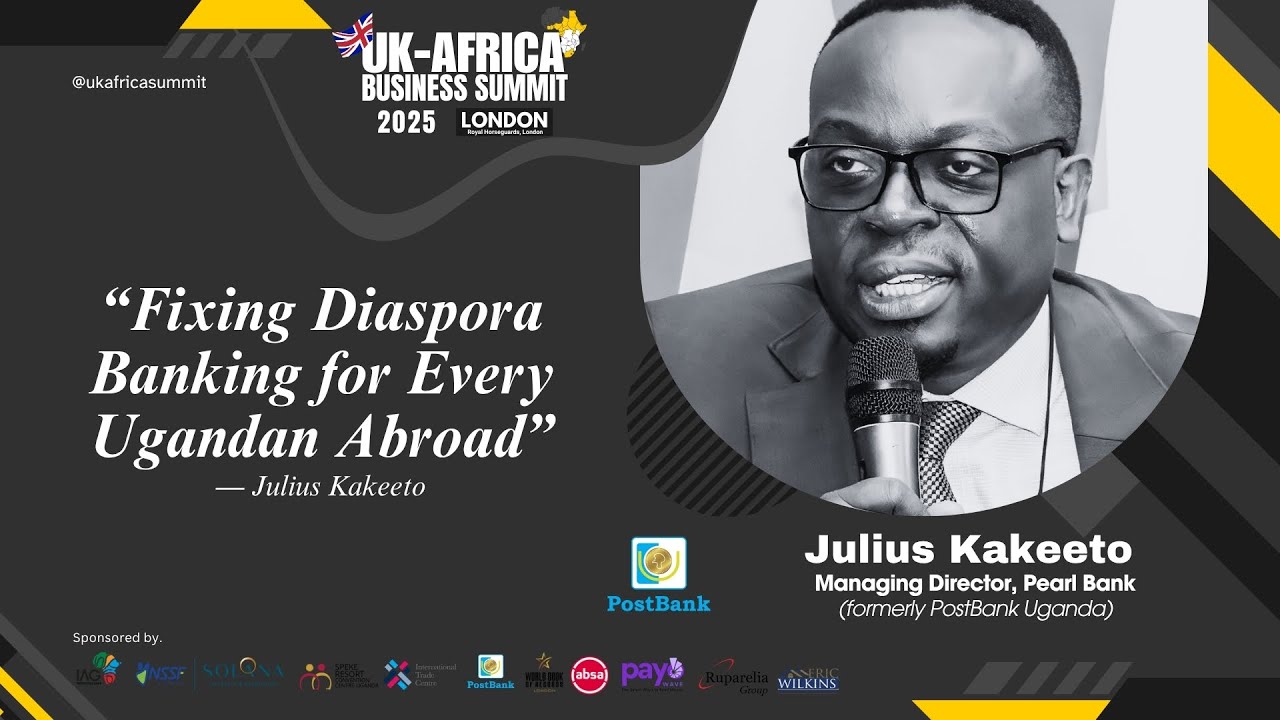
By Julius Kakeeto, Managing Director, PostBank Uganda (Rebranding to Pearl Bank Uganda)
📍 15th UK–Africa Business, Trade & Investment Summit 2025
🏛️ The Royal Horseguards Hotel & One Whitehall Place, London
Driving Financial Inclusion Through Trust and Innovation
Uganda’s financial transformation is redefining how citizens, businesses, and the diaspora interact with money. Speaking at the 15th UK–Africa Business, Trade & Investment Summit, Julius Kakeeto, Managing Director of PostBank Uganda (soon to become Pearl Bank Uganda), outlined how digital inclusion, regulatory reform, and institutional trust are reshaping Africa’s banking landscape.
Uganda’s financial ecosystem — once constrained by limited access and informal cash flows — is entering a new era of digital trust and integrated inclusion. The convergence of robust identification systems, compliance innovation, and open-data collaboration is transforming financial inclusion from aspiration into a scalable growth engine.
1️⃣ Insurance Penetration – The Next Growth Frontier
Uganda’s insurance penetration, currently less than 1% of GDP, remains one of Africa’s least developed financial sectors.
“There’s a very big opportunity in the insurance space,” said Kakeeto.
Through bancassurance, banks can now distribute insurance directly — embedding protection within loans and savings. This integration rebuilds consumer trust and positions insurance as a growth multiplier within the financial ecosystem.
“As financial inclusion expands, insurance will naturally grow,”
he added, noting that mobile platforms are already bundling insurance into digital finance products.
2️⃣ National ID Integration – A Digital Game-Changer
The integration of Uganda’s National Identification and Registration Authority (NIRA) database has revolutionised financial access.
“Identification is no longer a barrier — it’s become an enabler,” Kakeeto explained.
Through real-time API connections, banks can now verify customer identity in seconds, allowing rural citizens to open accounts remotely via mobile phones. This innovation has democratised access for millions of first-time savers, while reducing fraud and documentation errors.
3️⃣ Compliance and Corporate Onboarding
While individual access has improved, corporate onboarding remains complex.
“As soon as you mention ‘company,’ the compliance requirements multiply,”
Kakeeto observed. To address this, Uganda’s financial sector is digitising company registries and adopting transaction-based KYC — shifting compliance from static checks to behavioural verification, accelerating SME access to finance and strengthening regulatory integrity.
4️⃣ Insurance in Trade Finance – A Trust Multiplier
Trade finance often carries multiple layers of risk — from default to counterfeit goods. Kakeeto emphasised that insurance-backed instruments can de-risk supply chains and unlock affordable capital.
“There are multiple layers of risk — and not every insurer is willing to underwrite them all,”
he cautioned, calling for stronger collaboration among banks, insurers, and regulators.
5️⃣ Inclusion and Gender Equity
During the Q&A, panellists and delegates called for inclusive innovation.
- Clementina Aino, a mobile-money innovator, urged financial institutions to close the gender gap.
- Perez Ochieng, CEO of SACOMA Global Foods Innovation, highlighted that trade-finance costs can consume up to 90% of SME margins, calling for trust-based lending tools.
- A UK-based diaspora delegate raised remittance inefficiencies; Kakeeto confirmed that Pearl Bank’s rebranding includes digital infrastructure investments to deliver real-time rural service and seamless diaspora transactions.
6️⃣ The Way Forward – Digital, Trusted, and Inclusive
Kakeeto summarised Uganda’s transformation in four pillars:
- Robust ID systems – Real-time NIRA verification
- Open-data partnerships – Between banks, fintechs, and regulators
- Simplified compliance – For SMEs and informal enterprises
- Inclusive access – Ensuring women and rural communities benefit equally
“As we digitise access, we must also digitise trust,”
Kakeeto concluded — capturing the essence of Uganda’s inclusive financial revolution, where innovation, integrity, and inclusion drive sustainable growth.
Key Takeaway
Uganda’s digital-finance transformation demonstrates how technology, compliance, and inclusion can converge to build trust at scale. By linking identity verification, bancassurance, and digital trade finance, Uganda is setting a continental benchmark for Africa’s next-generation banking model — one where access meets accountability and growth serves everyone.